Free draw
Draw this turn without paying the chip.
How to play
You hold one Sand card and one Blood card. Get them to the same number and you have Sabacc. The lowest pair wins the round, everyone else pays, and the last player with chips takes the pot.
The decks
There are two decks, called families: Sand and Blood. Each has 22 cards: three of every number from one to six, three Impostors and one Sylop. Your hand is always exactly one card from each family.
Sand

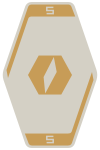

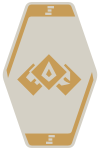

Blood
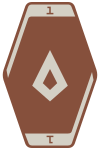
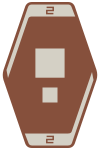
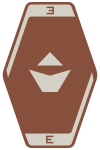
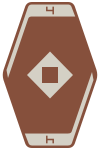
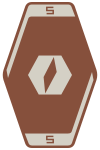



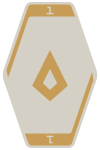
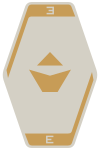
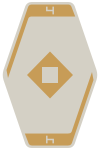
One to six, worth what they show. The shape in the middle is the number too, so a card can be read from across the table.
It has no number until the reveal. Then two dice are rolled for it and you choose which one it becomes. By that point every hand is face up, so you know what you need.
It copies the card beside it, so a Sylop with any card is a pair of that card. Two Sylops together are the best hand in the game.
What beats what
There are three kinds of hand. Any hand of a higher kind beats every hand of a lower one.
Two Sylops. Nothing beats it, and no shift token changes that.
Both cards the same number. The lower the pair the better: ones beat twos, and sixes are the weakest pair. A Sylop makes a pair with whatever it is next to.
beats Ranked by the gap between the two numbers, smallest first. If two hands have the same gap, the lower total wins.
beats Any pair beats any hand without one, however close. Six and six beats one and two.
Three turns each
Play goes clockwise from the dealer, three times round the table. On your turn you may first play one shift token. Then you must do one of two things.
Costs one chip
Take the top card of either deck, face down, or the face-up card on either burn pile. You now have two cards of that family: keep one and burn the other, face up. The chip is spent whichever you keep.
Free
Keep your hand as it is and pass the turn. Nothing changes and nothing is paid.
Chips you pay go in front of you as your chips in play. They are not lost yet: win the round and they come back.
A face-up burn card is the only draw whose result you know before you pay. If it completes your pair, take it.
After the third turn
So three and four is a cheap loss, one chip, and one and six is an expensive one, five. If you have no chips left once a round is settled, you are out. The last player holding chips wins the pot.
Sixteen of them
Each player is dealt two at the start of the game, and they are not replaced. A token is played at the start of your turn, before you draw or hold, one a turn at most, and then it is gone.
Tokens lie face up, so everyone can see what everyone else still holds. Four of them name another player.
Chips back Marked with dots. They put chips back in your stock, or save you from spending one.
Draw this turn without paying the chip.
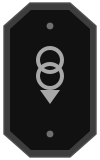
Take back two of the chips you have in play this round.
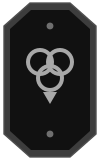
Take back three of the chips you have in play this round.
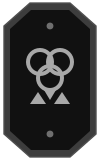
Take one chip in play from every other player and add it to your own chips in play.
Bending the ranking Marked with diamonds. They change which hand is best, for everyone, until the reveal.
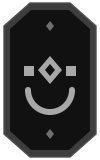
Every Impostor counts as a six until the reveal. No dice are rolled for them.
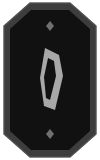
Pairs rank the other way round until the reveal: six and six is the best pair, one and one the worst.
Every Sylop counts as zero until the reveal, so it only pairs with another Sylop.
Roll two dice and choose one. A pair of that number beats every other pair until the reveal.
Taxes Marked with rings. They make other players put chips into the round.

Every other player pays one chip into the round.
The player you name pays two chips into the round.
Every other player who is holding pays two chips into the round.
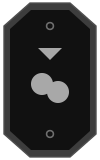
A player you name, who must be holding, pays three chips into the round.
Hands and turns Marked with stars. They act on another player’s hand or turn, or protect yours.
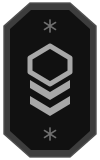
The player you name burns their whole hand and is dealt a new one, at no cost.
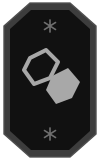
Swap hands with the player you name.
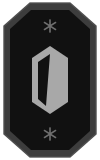
The next player to act must hold.
Until the reveal, no token can name you or charge you. It also lifts an embargo you are under.
Chips paid for a tariff or an audit go into the payer’s own chips in play. If that player wins the round, they get them back.
Edge cases